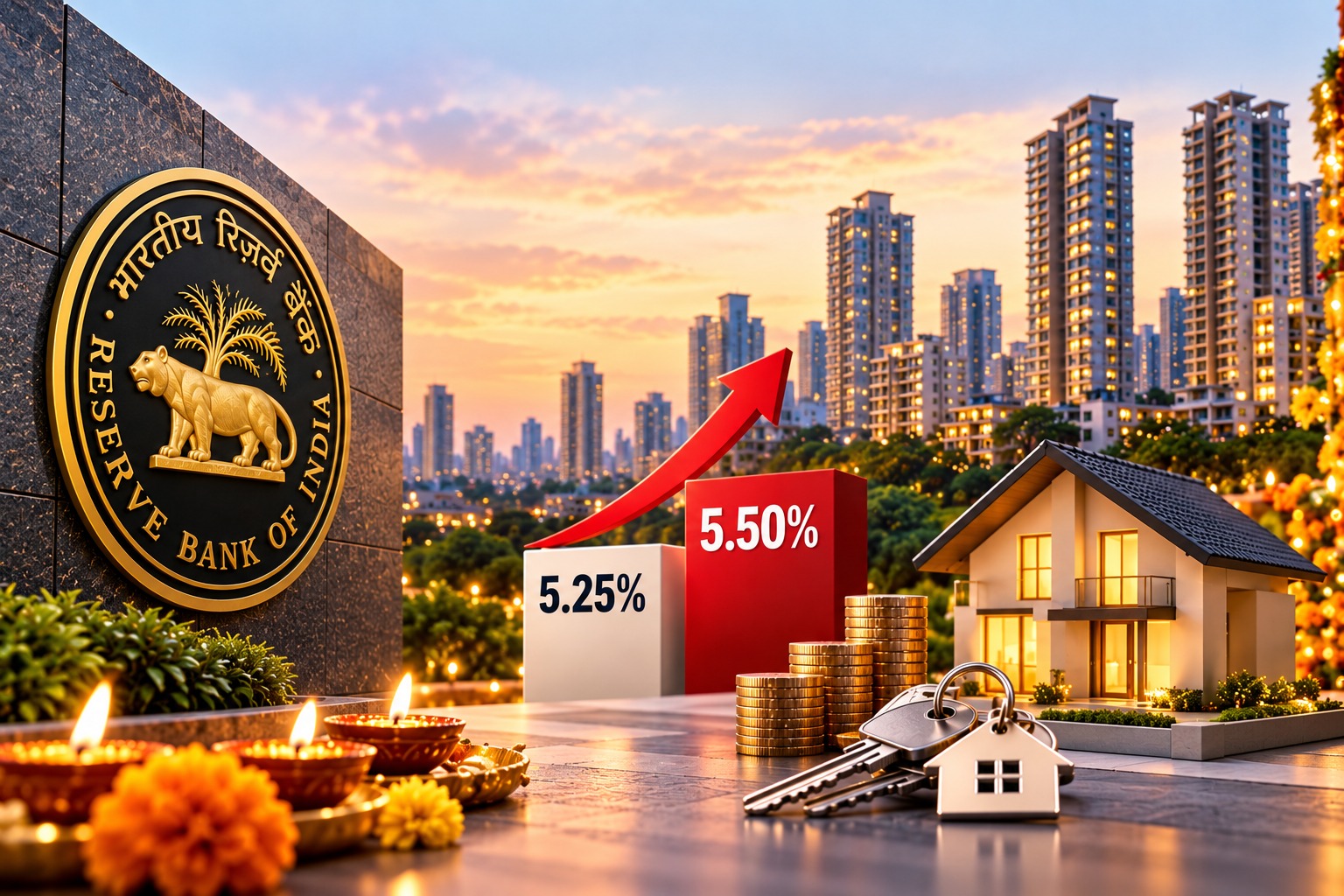

Just days before Navratri kicks off the festive property-buying season, the RBI has raised the repo rate by 25 basis points to 5.50%. The move puts home loan affordability to the test as developers enter a crucial sales window ahead of Diwali.
The timing comes as the residential market continues to show resilience, although the pattern of demand is changing. Across eight major cities, 258,238 homes were sold between January and September 2026, broadly in line with the year-earlier period, while 279,899 units were launched, up 4%. At the same time, demand has shifted towards higher-value housing, with sales of homes priced between Rs 2 crore and Rs 5 crore rising 19.4%, while sales below Rs 50 lakh declined 14%.
Mumbai has remained one of the stronger markets. The Mumbai Metropolitan Region recorded 72,804 housing sales in the first nine months of 2026, up 1% year-on-year and the highest nine-month sales volume since 2018. The region recorded 25,449 sales in Q3, its strongest quarterly performance since 2018, while unsold inventory declined 2% year-on-year.
The festive season now becomes an important test of whether this demand can withstand higher borrowing costs. Navratri and Diwali are traditionally key periods for property transactions, with buyers often bringing forward purchase decisions and developers stepping up launches and sales campaigns.
The RBI’s decision takes the repo rate to 5.50% after it was held at 5.25% for the previous four MPC meetings. It also marks a shift in the Monetary Policy Committee’s stance from ‘neutral’ to ‘calibrated tightening’, after an earlier easing cycle had brought the rate down by 125 basis points from 6.50%.
For homebuyers, the immediate concern is affordability. A higher policy rate can translate into higher lending costs, potentially prompting some buyers, particularly first-time and mid-income purchasers, to reassess their budgets or loan commitments.
However, the industry does not expect the latest increase alone to derail housing demand.

Vedanshu Kedia, Director, Prescon Group, said the 25 basis-point hike was a prudent response to renewed inflationary pressures arising from global crude prices and geopolitical developments. “While higher rates can have a direct bearing on home loan affordability, the increase is relatively modest and should not significantly disrupt the housing market,” he said.
Kedia said the underlying demand for housing remained strong, supported by demographic and economic factors. “The underlying demand for housing remains structurally strong, supported by India’s young urban population, with the median age in urban centres around 28 years, accelerating urbanisation and rising aspirations for better-quality housing. These demographic and economic trends continue to create a strong and sustained need for residential real estate.”
The broader economic outlook also provides some support to the sector. The RBI has raised its FY27 real GDP growth projection to 7.1%, with growth estimated at 7.2% in Q2, 6.9% in Q3 and 6.8% in Q4. CPI inflation is projected at 5.2%.

Rushi Mehta, Secretary, CREDAI-MCHI, said the stronger growth outlook should help the housing market absorb the rate increase. “The RBI’s upward revision of the real GDP growth forecast to 7.1%, with growth projected at 7.2% in Q2, 6.9% in Q3 and 6.8% in Q4, reflects the underlying resilience of economic activity. For real estate, sustained economic growth, income generation and consumer confidence remain important demand drivers,” he said.
The latest sales data, however, suggests that the impact of higher borrowing costs could vary across segments. The decline in sub-Rs 50 lakh sales indicates greater pressure at the affordable end, while the strong performance of the Rs 2-5 crore segment points to continued depth in premium housing.
In Mumbai, developers remain confident that infrastructure investment and redevelopment will continue to support demand even as borrowing costs rise.

Chintan Sheth, Chairman & Managing Director, Sheth Realty, said the rate increase could make some mid-income and first-time buyers more cautious, but Mumbai’s fundamental demand remained intact. “Robust end-user demand and the long-term fundamentals of Mumbai will continue to support the residential market. The emerging micro-markets such as Mulund, Sion and Borivali are gaining attention due to the increase in connectivity, infrastructure and long-term value potential,” he said.
Sheth added that redevelopment would remain an important growth driver by unlocking established neighbourhoods and creating new housing supply.

For developers, the focus is also likely to shift towards pricing, project execution and capital management. Rajendra M Rajan, Founder, TransIndia Group, said the rate hike could lead to more measured purchase decisions without fundamentally changing demand for well-located homes. “While a higher rate environment will lead to more measured purchase decisions, it is unlikely to change any fundamental demand for well-located and quality homes that offer stronger connectivity, established social infrastructure and long-term value,” he said.
The bigger question for the sector is whether the October hike is a one-off adjustment or the beginning of a longer tightening cycle. The change in stance to ‘calibrated tightening’ has made the RBI’s next moves particularly important for both buyers and developers.

Rohit Gera, Managing Director, Gera Developments, said the impact would depend on how long higher rates persist. “A strong economy and rising incomes remain the most important long-term drivers of housing demand. Much will now depend on whether this is a one-off recalibration or the beginning of a sustained rate-hike cycle. A limited increase can be absorbed; a prolonged tightening cycle would have a more meaningful impact on homebuyers and the sector,” he said.
For now, the focus shifts to the festive market. With Navratri beginning on October 11 and Diwali next month, the coming weeks will offer a clear indication of whether buyers continue to commit to property purchases despite higher financing costs. For developers, the festive sales numbers could provide the first real measure of how much the RBI’s latest move has changed the housing equation.