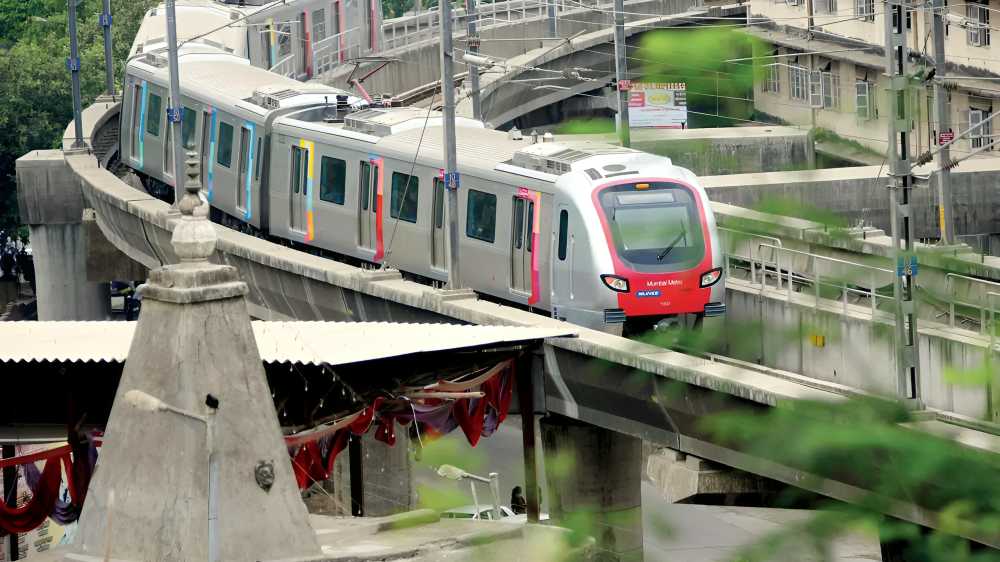

Mumbai Metro One will introduce a revised operating pattern on the Versova-Andheri-Ghatkopar corridor from August 10 to increase train frequency and passenger capacity during evening peak hours, particularly on the busy Andheri-Ghatkopar stretch.
Under the new system, trains will operate on a mixed-loop pattern. One train will run on a shorter route between Ghatkopar and Andheri, while the following train will continue on the complete Ghatkopar-Versova route. The operator said the change is aimed at improving the use of existing trains and infrastructure.
The revised schedule will reduce the peak-hour gap between trains on the Andheri-Ghatkopar section from 3 minutes and 20 seconds to three minutes. Mumbai Metro One expects this to raise carrying capacity on the stretch by more than 20 per cent, providing approximately 28,000 additional commuter capacity.
On the Versova-Azad Nagar section, the peak-hour headway will be 362 seconds under the new arrangement. The timetable will also increase weekday services from the existing 476 trips to 484 trips.
Evening peak services
Short-loop trains will operate during the evening rush period. The first such service will leave Andheri Down Platform at 6.23.06 pm, while the final short-loop train will depart at 8.23.46 pm.
Mumbai Metro One said the change is expected to benefit more than 85% of passengers travelling between Andheri and Ghatkopar, one of the most heavily used portions of the 11.4-km corridor.
Shyamantak Choudhury, CEO, Mumbai Metro One, said, “The mixed-loop operations are part of Mumbai Metro One’s ongoing efforts to optimise train operations and maximise the capacity of our existing infrastructure. By introducing this operational innovation during peak hours, we aim to reduce waiting times, enhance carrying capacity and provide faster, more convenient and reliable services to our commuters,” he told Sunday mid-day.
The revised system is expected to provide shorter waiting times, more frequent trains and greater passenger capacity while making better use of the existing metro infrastructure.
Source: Mid-day