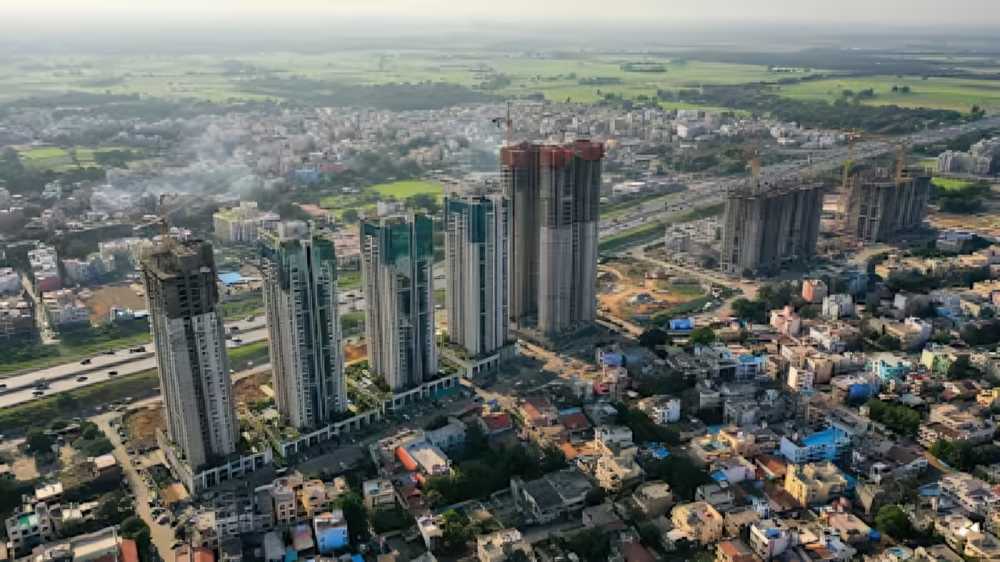

For years, Tier-2 cities had ample land to expand horizontally. But rising land prices, growing urban populations and improving connectivity are now pushing developers towards vertical growth.
Nashik, traditionally known for vineyards, temples and low-rise neighbourhoods, is witnessing a sharp change as developers plan residential towers reaching 40 and even 50 storeys ahead of the 2027 Kumbh Mela. The trend reflects a wider transformation across cities such as Nagpur, Indore, Jaipur, Ludhiana, Jalandhar, Coimbatore and Mangaluru.
“Defined city limits is one deciding factor. Mumbai is surrounded by the sea, Delhi has geographical boundaries with two states, Noida is bounded by Rivers Yamuna and Hindon. Another factor is availability of land as a resource. Horizontal expansion means longer commutes, costlier trunk infrastructure, and eating into agricultural land and or green cover at the city edge. So, state governments are relaxing floor space index and floor area ratio norms instead of spreading concrete footprints,” said Payas Agarwal, Director, Great Value Capital.
Higher FSI allows developers to accommodate more homes on the same land parcel while helping governments generate additional revenue through premium FSI. In Nashik, development regulations now permit buildings of up to 124 metres, enabling projects of approximately 40-42 floors, depending on design.
The city’s property market is also expanding. Registrations reached ₹17,543 crore in 2025-26, while the number of properties has risen from about 3.8 lakh in 2014-15 to nearly six lakh today.
Rising land costs are another major factor behind the shift. Developers can distribute expensive land costs across a larger number of units by building upwards.
However, vertical growth brings significant infrastructure challenges. Higher-density developments increase pressure on roads, water supply, sewage systems, electricity, parking, waste management and emergency services.
“If infrastructure planning does not grow along with density… One would not blame the height of a building. Height doesn’t create pressure on a city. Population without supporting infrastructure does. A well-planned high-density development connected to strong roads, transit and municipal infrastructure can be far more sustainable than endless urban sprawl,” said Snehith Reddy Meda, Partner, E-infra.
As Tier-2 cities embrace high-rise development, planners face a crucial task: ensuring infrastructure grows alongside density. “The ambition shouldn’t be to build the tallest India possible. It should be to build the most liveable India possible,” Meda said.
Source: News18