
Residents of Simplex Colony in Ghansoli Sector 7, Navi Mumbai, have launched a protest after the Navi Mumbai Municipal Corporation’s (NMMC) General Assembly deferred further action on the proposed Urban Renewal Scheme (URS) for the long-pending redevelopment of the colony.
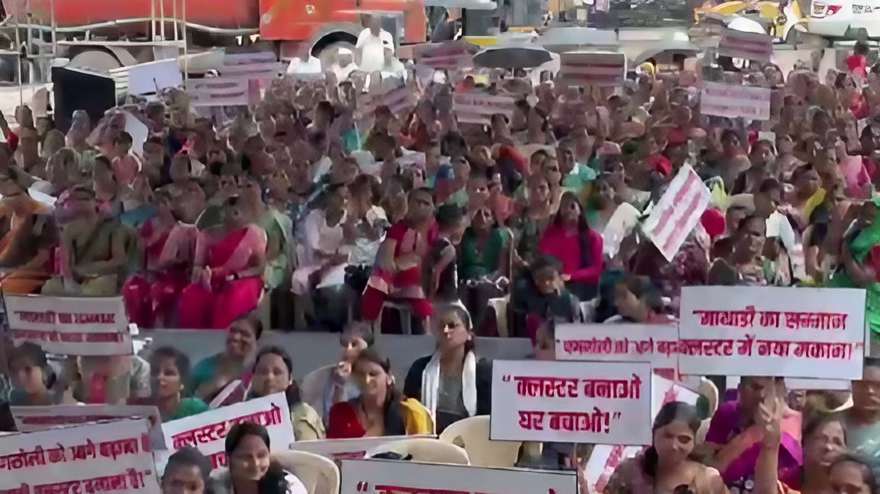
Thousands of residents took to the streets on Sunday, demanding that the redevelopment proceed through the cluster model. Residents fear that the latest decision could once again push back a project that has remained unresolved for several years.
Built in 2004-05 for Mathadi workers and other working-class families, Simplex Colony comprises 3,168 flats, 96 shops and seven cooperative housing societies. Many homes, measuring around 180 sq ft, have reportedly faced problems including water leakage, cracks in walls and damaged slabs. Residents have therefore argued that redevelopment is not merely about obtaining larger homes but also about addressing safety concerns.
The colony was included in Cluster No. 4 under the NMMC’s Urban Renewal Plan notification issued on July 14. The cluster covers approximately 67,146 sq m, and suggestions and objections were invited as part of the process. Residents had expected the inclusion to accelerate redevelopment.
However, during the General Assembly meeting, a proposal was raised to first assess the impact of higher Floor Space Index (FSI) on Navi Mumbai’s existing infrastructure. Issues including water supply, roads, transportation, solid waste management, parking and healthcare facilities were cited.
Ruling BJP corporators argued that the city’s carrying capacity should be assessed before allowing further progress under the URS, given the long-term infrastructure implications of increased construction potential. The General Assembly subsequently deferred further action.
The decision has triggered dissatisfaction among Simplex residents. While they do not oppose an infrastructure-capacity study, they maintain that the assessment should not become a reason to indefinitely halt redevelopment.
The issue has also exposed differences among political groups. BJP corporators have advocated self-redevelopment and urban restructuring through the municipal corporation, while Shiv Sena (Eknath Shinde) corporators have supported advancing redevelopment through the URS, citing residents’ longstanding difficulties.
Residents, meanwhile, have urged political parties and the civic administration to keep their housing and safety concerns at the centre of the debate. They fear that prolonged discussions over FSI, infrastructure capacity and redevelopment models could leave thousands of families waiting even longer for safer and larger homes.
Source: Loksatta