Mumbai’s expansion is often measured in new infrastructure and rising skylines, but its most pressing challenges lie beneath the surface, in how the city manages its waste and water.
This burden falls disproportionately on ageing landfill sites such as Deonar and Kanjurmarg. The latter alone handles nearly 80% – 90% of Mumbai’s waste, highlighting the city’s overdependence on a single disposal system. Over 5,500 tonnes are processed there daily, even as operational costs continue to rise sharply, reflecting the inefficiency of a centralised dumping model. Meanwhile, decades-old waste accumulations remain largely untreated, creating long-term environmental and public health risks.
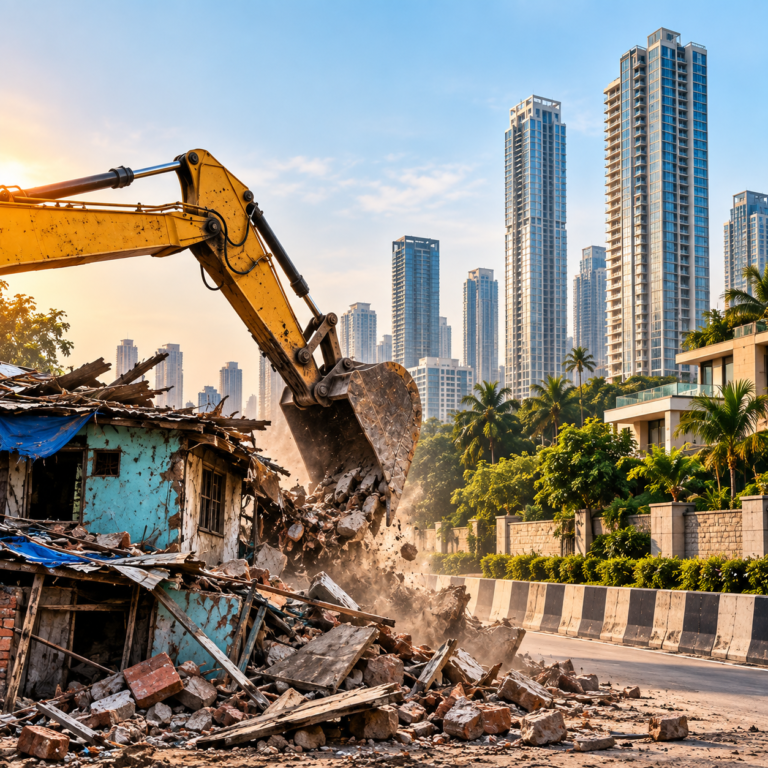
The problem is further intensified by the surge in construction and demolition debris, which now exceeds 8,500 tonnes per day, nearly matching municipal waste volumes. This is a direct consequence of Mumbai’s redevelopment boom, where infrastructure growth paradoxically generates a parallel waste crisis that existing systems are ill-equipped to handle.
Water presents a similarly complex challenge. The Brihanmumbai Municipal Corporation (BMC) supplies roughly 4,000 million litres per day, yet this headline figure masks deep inefficiencies. Leakages, unauthorised connections and ageing pipelines result in significant transmission losses, while distribution remains uneven across neighbourhoods. As a result, even areas within the city routinely rely on tanker supplies, indicating that availability does not translate into equitable access.
Future projections further strain this fragile balance. With population density intensifying and redevelopment accelerating, water demand is expected to outpace supply in the coming years. The civic body’s own plans to augment supply, including desalination and infrastructure upgrades, acknowledge a widening demand-supply gap, requiring thousands of crores in capital investment.
What emerges is a pattern of reactive, rather than anticipatory, urban planning. Waste continues to be transported long distances at high financial and environmental cost, instead of being processed closer to its source. Water infrastructure is expanded, but systemic inefficiencies remain unaddressed. In both sectors, the emphasis has been on scaling capacity rather than improving management.
Mumbai’s growth, therefore, carries hidden costs that are neither reflected in real estate valuations nor infrastructure announcements. Environmental degradation, fiscal strain and declining service quality are already visible outcomes. Without a decisive shift towards decentralised waste processing, reduction at source, and comprehensive water management reforms, these pressures will only intensify.
A city that aspires to global stature cannot afford to treat waste and water as afterthoughts. They are, in fact, the most fundamental indicators of whether Mumbai’s growth is sustainable, or merely expansive.
Mumbai’s streets are increasingly being used not for movement, but for storage. The growing scramble for parking space is quietly reshaping how…
Learn moreMumbai’s urban story has always been shaped as much by scarcity as by opportunity. Today, as infrastructure demands surge and fiscal pressures…
Learn moreMumbai’s business hubs may be shifting. With new roads, bridges, and the upcoming international airport, Navi Mumbai is emerging as more than…
Learn moreIf stamp duty remains merely a fiscal cash cow, the property market will continue to move in volatile cycles. But used strategically,…
Learn more