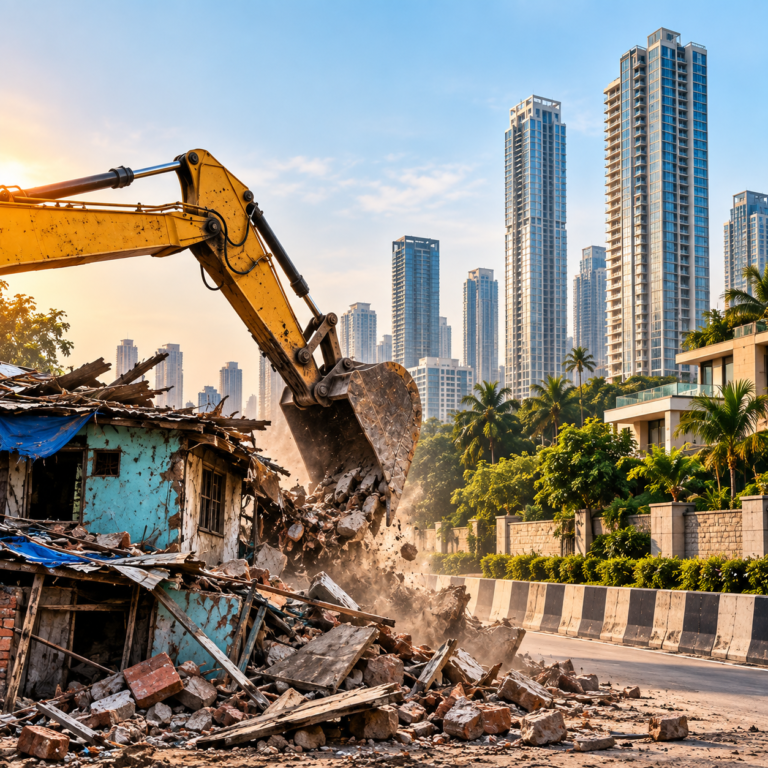
Mumbai has discovered a remarkable new principle of urban governance: the law is blind, but the bulldozer apparently has excellent eyesight.
Fair enough. If a resident converts a common lobby into living space, encloses a duct or absorbs a ventilation shaft into a private flat, the rules should apply. Common areas are common for a reason, and sanctioned plans cannot become suggestions once possession is handed over.
But Mumbai's residents are entitled to ask a rather inconvenient question: why this building, and why now?
Because Rustomjee Crown is hardly the first residential complex in the city where walls have mysteriously moved, balconies have grown, ducts have disappeared and common spaces have acquired new owners. In Mumbai's housing landscape, unauthorised alterations are hardly an exotic species. They are practically part of the urban ecosystem.
We have seen illegal structures demolished in slum pockets, unauthorised portions removed from individual properties and entire redevelopment controversies dragged through courts and government offices. The city has even witnessed cases where illegal floors became national news and reached the Supreme Court. Yet the broader question remains: how many other buildings are receiving the same forensic attention?
If 138 notices can be issued in one high-rise, perhaps the BMC could publish a list of the other high-rises where similar complaints have been received. Better still, let there be a citywide audit of common-area encroachments and unauthorised alterations.
That would make this about enforcement rather than headlines.
Otherwise, Mumbai risks creating an unfortunate impression: that the law does not necessarily arrive when a violation occurs; it arrives when someone complains loudly enough, the paperwork reaches the right desk and the case becomes impossible to ignore.
The BMC insists that due process was followed at Rustomjee Crown. Good. Now apply the same process everywhere. Because the real test of civic authority is not whether it can demolish nine illegal alterations in a luxury tower. It is whether it has the appetite to find the ninth alteration in the ninth building nobody is talking about.
Mumbai doesn't need selective demolition. It needs predictable enforcement. If an alteration is illegal, remove it. If it is legal, leave it alone. And if thousands of similar violations exist elsewhere, perhaps the bulldozer should be given a map.
In Mumbai, luxury is increasingly about doing more with less: smaller apartments, longer amenity lists, and a growing talent for making limited…
Learn moreIn Mumbai’s redevelopment economy, the most valuable space in a home may no longer be the living room, the balcony or the…
Learn moreThe dream of owning a Mumbai home comes with more than a price tag. The additional costs, more often than not, arrive…
Learn moreMumbai’s obsession with higher Floor Space Index (FSI) risks building taller towers without solving deeper urban challenges. Mumbai has discovered its ultimate…
Learn more