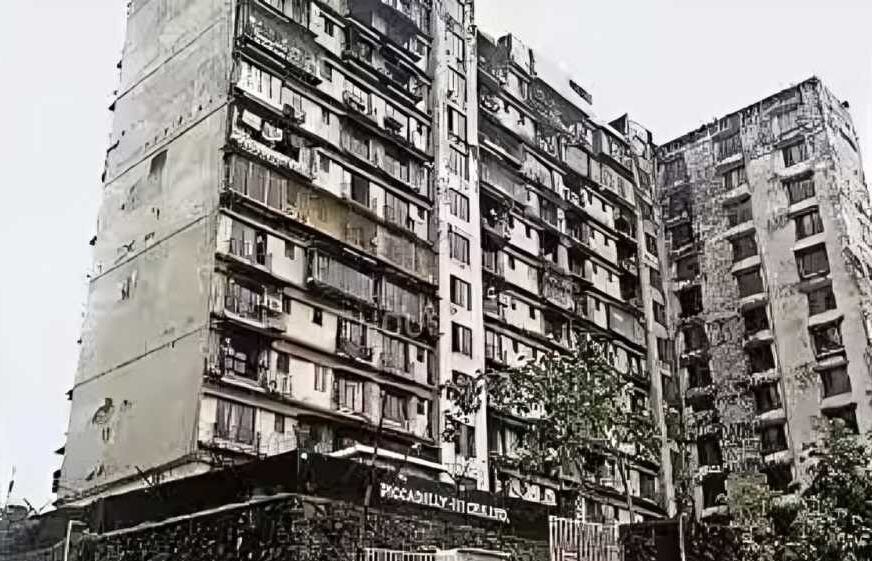
A new analysis found that between 2005 and 2022, the amount of land covered by slums in the Mumbai region decreased by 8.6% or 4.1 square kilometres. That’s around 4.5 times the size of the Mahalaxmi Racecourse.
The study discovered that the area covered by slums in estuarial Mumbai — Greater Mumbai and Thane city — decreased from 47.7 square kilometres in 2005 to 43.6 square kilometres in 2022. This general drop, however, masks a more nuanced dynamic: some bastis grew larger, others shrank, and a few vanished over the last two decades. According to the findings, slums shrank in certain areas by 10.2 square kilometres while expanding in others by 6.1 square kilometres.
Friesen and colleagues used high-resolution satellite imagery and other data to map changes in acreage occupied by slum constructions throughout Mumbai between 2005 and 2022. With a total land size of about 600 square kilometres (including the national park), the reduction brought the share of land occupied by slums in the Mumbai region from 8% in 2005 to 7.3%.
Meanwhile, on the mainland, including Navi Mumbai and parts of Mumbra, the area of slums increased by over 35% between 2005 and 2022, from 12 to 16.1 square kilometres. Researchers also investigated the spatial density of slums, which they calculated based on the distance between structures. Slum areas with less than a 10-metre interval between structures were classified as high density, while those with gaps of up to 30 metres were labelled low density.
Researchers discovered that the number of low-density slums in the region quadrupled from 294 to 502 between 2005 and 2010, then dropped back to 266 by 2022. Conversely, the number of densely packed, or high-density, slums decreased somewhat in 2010, from 988 to 964, before rising to 1,359 by 2022.
These findings appear to confirm local views that slums in the city have developed vertically rather than horizontally over the last decade and that any sprawl in informal settlements has relocated outside the metropolitan zone. Interestingly, the study discovered that slums near waterbodies and railways decreased over 17 years. Between 2005 and 2022, slum areas near 100 meters of waterbodies decreased by 7%, or 1.8 square kilometres, and by 11.5%, or 3.7 square kilometres, within 100 meters of railway lines.
Source: The Times of India