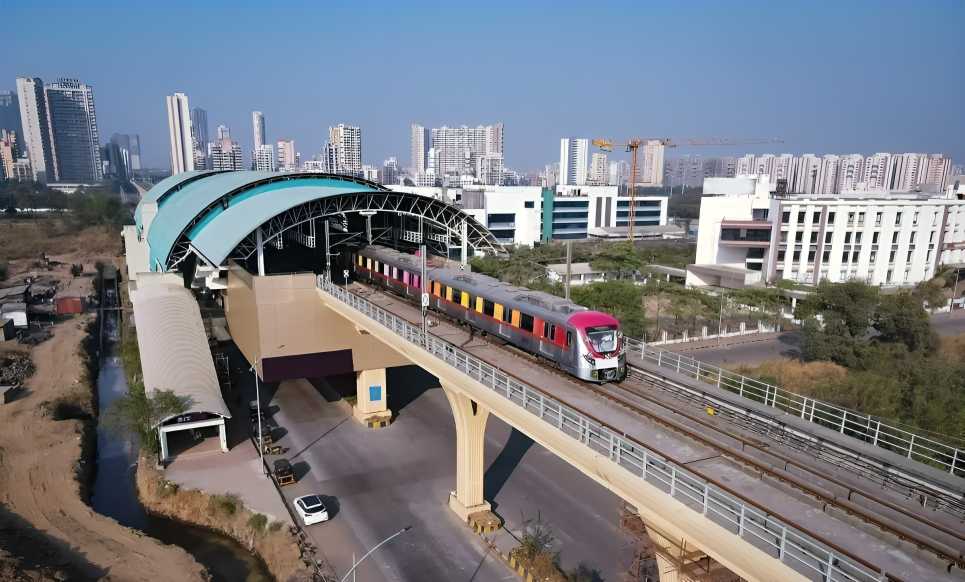

Mumbai’s metro expansion has reached a significant construction milestone with the successful installation of a crucial structural span over one of the busiest suburban railway corridors in the western suburbs. The achievement marks steady progress on Mumbai Metro Line 6, which is expected to enhance east–west connectivity across the city.
The latest engineering feat involved placing a steel span across active railway tracks between Jogeshwari and Ram Mandir—a section known for frequent train movement and limited working space. The work required meticulous coordination with railway authorities, as construction activities were restricted to short overnight blocks to avoid disrupting daily commuter services.
Prior to launching the span, engineers had to build a supporting pier within a narrow gap between parallel railway lines. This task was particularly challenging due to continuous train operations and strict safety protocols. Experts highlight that such projects demand careful planning around vibration control, structural stability, and adherence to railway safety standards.
Progress on Mumbai Metro Line 6 underscores the complexities of developing transit infrastructure in densely populated cities. Unlike greenfield projects, construction in urban environments must navigate existing systems such as railways, utilities, and roads, often without interrupting essential services.
Urban mobility specialists emphasise that corridors like this are vital for redistributing transport demand across the metropolitan region. By linking important residential and commercial areas, the line is expected to ease pressure on overcrowded suburban railways and congested roads. Strengthening east–west connectivity is particularly crucial in Mumbai, where most transport networks are aligned along a north–south axis.
From an environmental standpoint, expanding metro infrastructure can help lower vehicular emissions and improve air quality by encouraging a shift from private vehicles to public transport. However, experts stress the importance of integrated planning, including seamless interchanges, last-mile connectivity, and pedestrian-friendly access, to fully realise these benefits.
The successful execution of this span also reflects evolving construction practices in India, with greater use of prefabrication, heavy-lift techniques, and coordinated project management. As work progresses, the project is expected to play a key role in shaping Mumbai’s future mobility landscape.
Source: Urban Acres