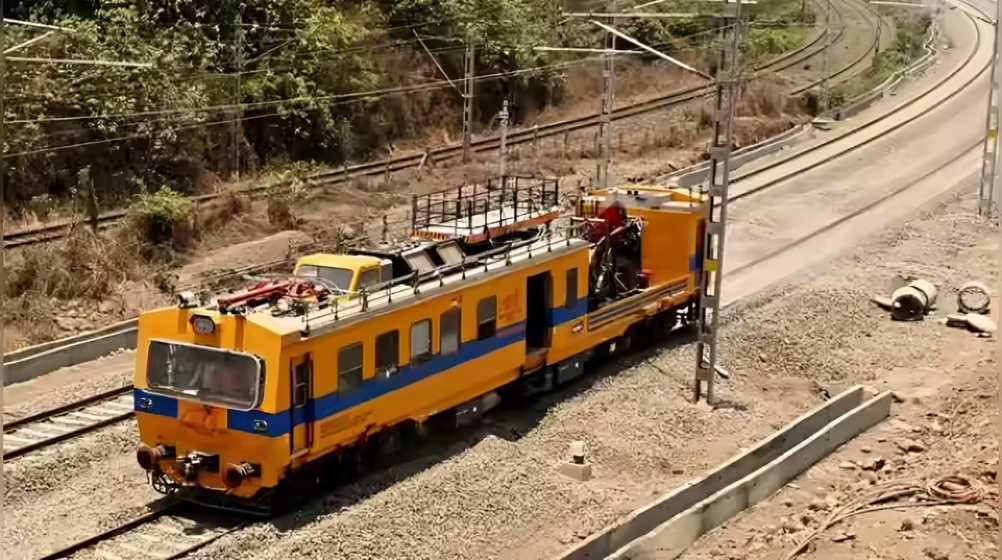

Construction activity on the Mumbai–Delhi Dedicated Freight Corridor has picked up pace in Navi Mumbai, with visible progress reported on key stretches, including the Ulwe region, where a maintenance vehicle train was recently seen operating on newly laid tracks. The movement marks an important phase of testing and ongoing infrastructure development within the Western Dedicated Freight Corridor (WDFC) network.
The Western Dedicated Freight Corridor is a flagship rail infrastructure project connecting Dadri in the National Capital Region to the Jawaharlal Nehru Port Authority (JNPA) in Navi Mumbai. Designed as a high-speed and high-capacity freight-only railway line, the corridor aims to significantly improve cargo movement efficiency between northern and western India, particularly along the busy Mumbai–Delhi logistics route.
The project aims to create a dedicated freight pathway that separates cargo traffic from passenger rail services. By diverting freight trains away from conventional mixed-use railway lines, the corridor is expected to reduce congestion on existing routes, enhance operational efficiency, and improve overall rail network capacity nationwide.
Spanning critical logistics hubs, the corridor strengthens rail-based freight connectivity between Dadri and JNPA, enabling faster and more streamlined movement of goods. Officials say the infrastructure is being designed to support large-scale cargo handling with reduced transit time and improved reliability.
In Navi Mumbai, significant progress has been reported on multiple segments of the corridor. The Taloja–Bhiwandi stretch, in particular, is nearing completion, marking steady advancement in one of the key regional sections of the project. This segment forms an important link in the broader freight network being developed across Maharashtra.
Large-scale engineering works are also underway, including the installation of massive girders and supporting structures essential for elevated and at-grade track development. These civil works are crucial for ensuring structural stability and long-term operational efficiency of the freight corridor.
The recent sighting of a maintenance train on the Ulwe tracks indicates that preliminary testing and inspection activities are underway, signalling continued momentum in construction progress. Such trials are typically conducted to assess track alignment, safety parameters, and readiness for future freight operations.
Once operational, the corridor is expected to play a key role in decongesting existing railway lines by shifting bulk cargo movement to a dedicated high-speed route. This transition will free up capacity on conventional passenger and mixed-use rail networks, allowing smoother scheduling and improved service reliability.
With multiple segments advancing simultaneously, the Mumbai–Delhi Dedicated Freight Corridor continues to move closer toward partial operational readiness, reinforcing its role as one of India’s most significant logistics infrastructure projects.
Source: The Times of India