
A fresh communication from Maharashtra’s Urban Development Department has brought renewed attention to the approval process for Permanent Transit Camp (PTC) projects in Mumbai, with real estate stakeholders expecting greater clarity on the roles of the Slum Rehabilitation Authority (SRA) and the Brihanmumbai Municipal Corporation (BMC).
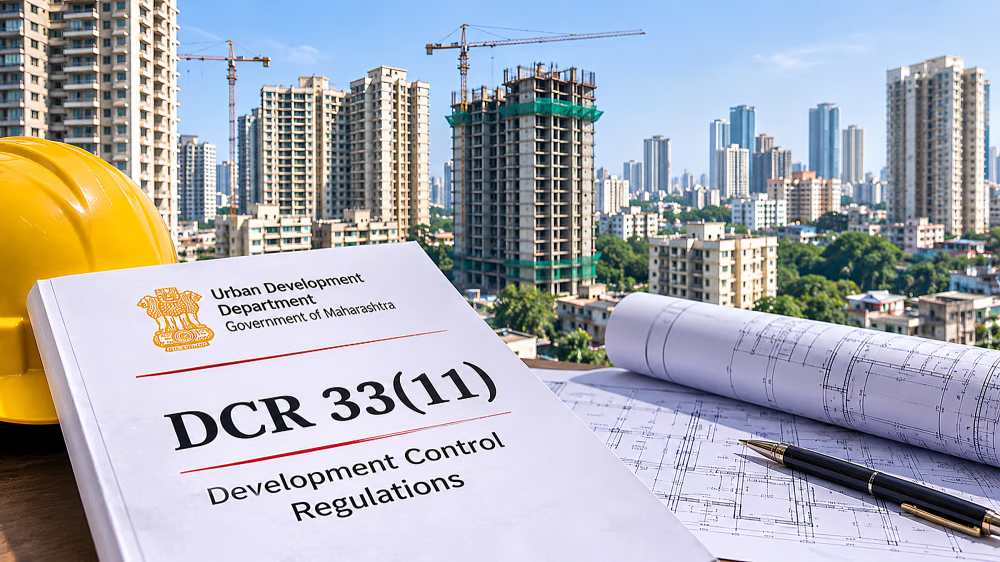
Maharashtra’s Urban Development (UD) Department has reiterated its earlier directions on Regulation 33(11) of the Development Control and Promotion Regulations (DCPR) 2034, signalling that the Slum Rehabilitation Authority (SRA) should continue processing proposals under the provision in accordance with the state government’s October 15, 2024 directions.
In a communication dated November 2, the department asked the SRA to follow the existing government instructions, bringing some relief to developers who have been facing uncertainty over the authority responsible for approving such redevelopment proposals.
BMC-SRA Dispute Over Approval Powers
The issue gained prominence after the Brihanmumbai Municipal Corporation (BMC) questioned the SRA’s authority to approve projects under Regulation 33(11), particularly those involving non-slum plots.
In a letter dated July 22, 2026, the BMC Commissioner approached the state government seeking clarity on the jurisdiction and requesting that the regulation be brought under the civic body’s authority.
The SRA, in its September 2 response, maintained that Regulation 33(11) was carried forward from Regulation 33(14)(D) under the Development Control Regulations (DCR) 1991. It also referred to provisions governing permanent transit camps, premiums, charges and restrictions on plot amalgamation.
The latest communication from the UD Department reiterates the earlier directions but does not constitute a fresh order on the BMC’s jurisdictional demand.
Mumbai’s Growing Need For Transit Housing
Regulation 33(11) facilitates the creation of Permanent Transit Camp (PTC) tenements to accommodate people displaced by infrastructure projects and redevelopment activities.
According to SRA figures, 522 approved schemes have generated 32,337 Project Affected People (PAP) tenements, of which 6,604 have been handed over. Mumbai’s current requirement is estimated at around 50,000 such tenements, while the Development Plan projects a requirement of 2.2 lakh units.
Developers Welcome Regulatory Clarity
Industry representatives have welcomed the department’s communication, emphasising the need for continuity in the approval process.
Ar. Shantanoo V. Rane, Chairman, Roswalt Realty, said the regulation had been successfully implemented by the SRA for several years. He pointed out that several locations in Mumbai have slum and non-slum plots situated close to each other. Allowing these plots to be amalgamated under SRA supervision could simplify approvals and accelerate the creation of transit housing.
Sukhraj Nahar, President, CREDAI-MCHI, said the industry expected the existing system to continue, adding that clarity and continuity were essential for developers.
Boman Irani, Chairman, Rustomjee, welcomed the government’s communication, noting that Regulation 33(11) had contributed significantly to the supply of transit tenements required for Mumbai’s infrastructure and rehabilitation projects. He stressed the importance of having a predictable approval mechanism.
Amit Thacker, Managing Director, SD Corp Holdings, said Regulations 33(11) and 33(20)(B) could operate simultaneously, giving developers the flexibility to pursue proposals through the appropriate authority.
He expressed hope that the SRA and BMC would process their respective schemes, helping accelerate the creation of transit homes.
The industry will now be watching how the two authorities implement the existing framework and whether the latest communication helps prevent further delays in projects requiring transit accommodation.
Source: The Free Press Journal