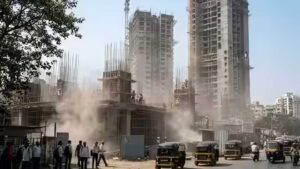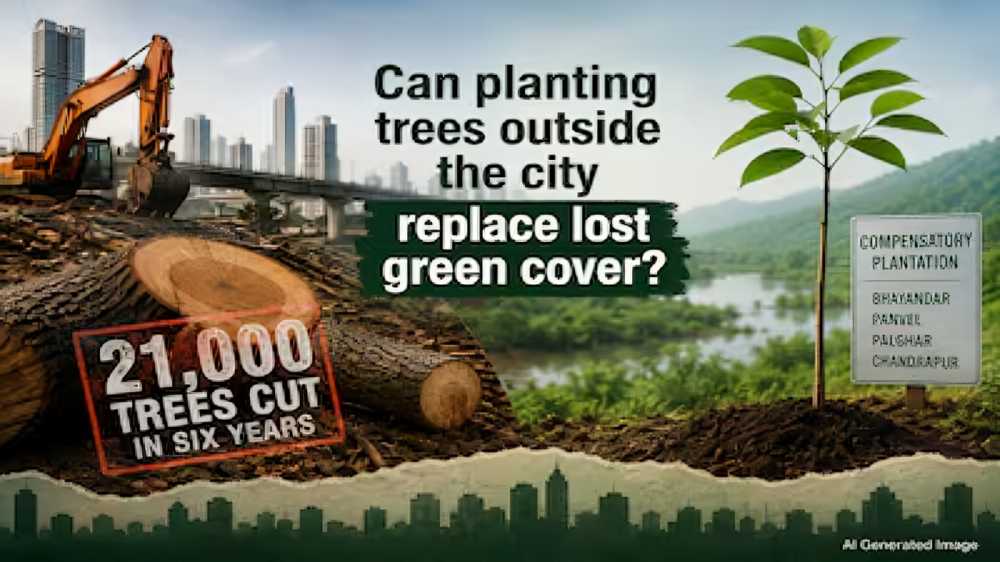

Mumbai’s rapid infrastructure expansion has transformed the city’s transport network, but it has also led to a significant decline in its green cover. According to data obtained through the Right to Information (RTI) Act, more than 21,000 trees have been felled in Mumbai over the past six years for projects including roads, railway corridors and the Mumbai-Ahmedabad Bullet Train. The growing concern now extends beyond the number of trees cut to whether plantations outside the city can truly compensate for the environmental loss within Mumbai.
Major infrastructure projects often require large parcels of land, making tree removal unavoidable in a densely populated city. The Rs 14,000-crore Goregaon-Mulund Link Road alone requires the felling of over 1,000 trees, while the Mumbai High Court has permitted the removal of around 45,000 mangrove trees for the Rs 18,300-crore Versova-Bhayandar Coastal Road project. As compensation, the BMC has proposed planting more than 1.3 lakh mangrove saplings.
Under Maharashtra’s tree authority rules, three trees must be planted for every tree removed. However, identifying suitable land within Mumbai remains a major challenge. For several projects, compensatory plantations have been planned in locations such as Panvel, Palghar, Bhayandar and Chandrapur instead of within the city.
“If we get land in Mumbai, we will plant in Mumbai. But under the rules, when trees are cut, compensatory plantation has to be carried out wherever suitable land is available. If land is available in places like Panvel, we have to undertake plantation there,” said Ganesh Khankar, House Leader in the BMC.
Environmentalists argue that replacing mature urban trees with saplings planted far from Mumbai does not address the immediate ecological loss experienced by city residents. Mature trees provide shade, reduce temperatures, improve air quality, absorb carbon and minimise noise pollution in densely populated neighbourhoods.
“We live in Mumbai. I live in my house. I go to my office. Maybe I am a student, I am going to my school. I need trees around me. What will I do with a tree which is 100 kilometres away?” said Subhajit Mukherjee, Founder of Mission Green Mumbai.
The concern is reinforced by Mumbai’s Climate Action Plan and Climate Vulnerability Assessment, which reported that the city lost over 2,000 hectares of green cover between 2016 and 2021 due to rapid urbanisation. The report also noted that Mumbai’s average temperature increased by more than 1°C between 1973 and 2020, highlighting the role of shrinking green spaces in worsening urban heat.
Residents have also experienced the effects firsthand. “I live in Thane, in Hiranandani Estate, and it has been built in such a way that it is very green, very green. The moment I step out of that whole complex, it’s like hell. Honestly, there are no trees,” said Jasneet Singh, a Thane resident.
While Mumbai urgently needs new roads, metro lines and transport infrastructure, experts believe development and environmental conservation must progress together. The debate is no longer limited to planting three trees for every one removed. Instead, it centres on whether replacement plantations are located where they can restore ecological balance, improve urban living conditions and survive long enough to deliver the benefits that mature trees once provided.
Source: CNBC TV18